Become an explorer
Imagine you are an explorer. Every element here can be explored. Go through games for logic and dexterity, explore all possible moves and measure the strength of the wind.
Article by N+1
3 min to read · May 24 2023

present…

Instruction
We invite you to play an explorer. Look at familiar things from a different angle. Imagine for a while that everything around you is your science experiment.
Consider the space. Could the whole structure be a large crystal lattice?
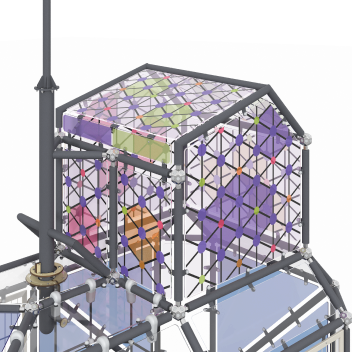
A crystal lattice is the internal structure of a crystal, which is formed of atoms, ions or molecules arranged in a strict order. The points at which these particles are located are called the nodes of the lattice. The particles are held in place by chemical bonds between them.
Now let's look at the patterns, you can find them on the second floor. In sunny weather it is very interesting to watch this mosaic, to see how the rays are refracted, how the multicolored light falls.
Make an experiment on dexterity and wit: what is the fastest way to get to the second floor? And how to do the same and spend less energy and effort? What tricks do games have? The challenges are many! Make up your own and make them up to your friends.
"Science" is a large complex. Here you can find various games for logic and dexterity. Remember that science is always with us. You just need to take a good look.
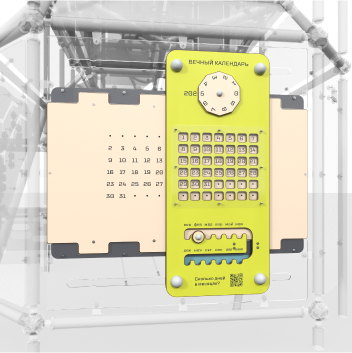
"The Perpetual Calendar" game
To select the year, rotate the circle. To choose the month, use the panel: move it to the left or right and move the chip. Don't forget the days of the week! All dates must coincide exactly with the real calendar. This way you can customize any month in any year.
But there may be extra dates at the end of each month, for example in February the grid will still go to the 31st. That's okay, just ignore it. Your task is to match the dates and days of the week correctly.
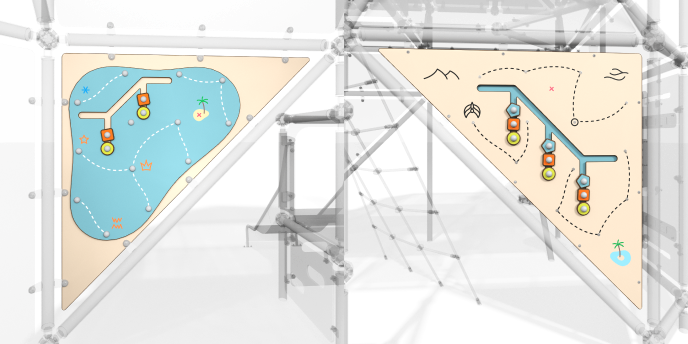
"The clean up the mess" game
There are two ways to play this game. You can distribute the chips in separate rows by shapes and colors. Or you can collect sets of different chips in separate columns.
"Hit the Goal" game
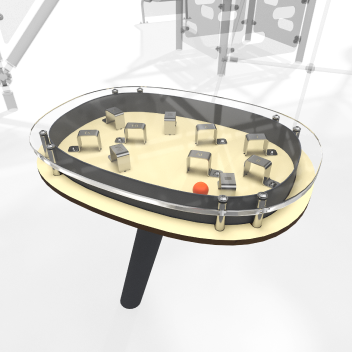
You have one ball and 10 gates. You need to hit each of them. Tilt the panel to control the ball. Go through all the gates one by one.
If several people will participate in the game at once, you can pass the way through all the gates for time. The one who copes faster, the one who wins. To complicate the task, you can pass the route through all the gates several times.
All the gates are labeled with Roman numerals. Roman numerals appeared 500 years before our era, they were invented by the Etruscans. There is a theory that the Etruscans followed the simplest and at the same time the most ingenious way of creating numbers. They drew from the image of the human hand. For example, 1, 2 and 3 are designated by the number of fingers (I, II, III). And the Roman numeral V depicts an open hand with four fingers pressed together and the thumb set aside. The symbol X represents two crossed arms or a double numeral V.
Roman numerals are written as follows (1 through 12): I, II, III, IV, V, VI, VI, VII, VIII, VIII, IX, X, XI, XII, and so on. The digits I (one), V (five), X (ten) can be used to represent many different numbers.
The Roman number system is a non-position number system in which the value of a digit is clearly defined and does not depend on its position in the number. The letters of the Latin alphabet are used to write numbers: I stands for "one" (1); V stands for "five" (5); X stands for "ten" (10).
In normal life, we use Arabic numerals. This is the traditional name for a set of ten characters that is used in most countries: 1, 2, 3, 4, 5 and others. Interesting fact, Arabic numerals were not invented by the Arabs at all. They originally appeared in India. And the name "Arabic numerals" was formed historically, due to the fact that these signs came to Europe through the Arab countries.
Arabic numerals are a positional number system, that is, the meaning of numbers is determined according to their position in the record. The position of digits in numbers can represent units or tens. For example, in the number 12, the digit 1 represents ten, and in the number 122, it represents a hundred. In non-position number systems, no matter where a digit is located, it retains the same meaning either way. For example, in Roman number systems IV and XI, the numeral I means one.
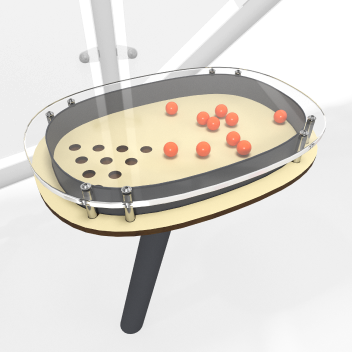
"Hit the hole" game
You need to get all the marbles into the holes. And that's not so easy!
If several people participate in the game, you can perform this task for time. Whoever can do it faster, wins the game.
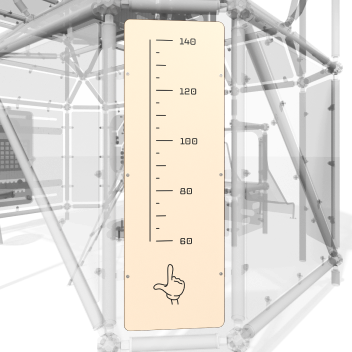
"Height Meter"
Find out your height! The ruler is designed for heights up to 140 centimeters.

"Catch the Wind" game
Do a real experiment. Find out how much current the wind generates.
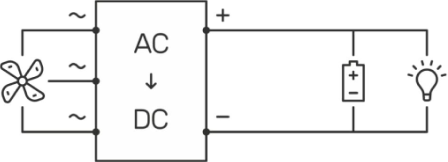
How do you do that?
You need to turn the direction of the blades towards the wind. Watch the propeller. The faster it spins, the more electric current is produced. Find out exactly how much current the wind is producing right now. Observe the voltage on the voltmeter, the amperage on the ammeter, and the power of the current produced by the wind on the power meter.
A simple formula is constructed by Ohm's law: power P in watts [W] is equal to the voltage U in volts [V], multiplied by the current I in amperes [A]:

Check yourself by looking at the response on the power indicator.
This article is about our product:
More articles by N+1
Electric Quest
Imagine you are an explorer. Every element here can be explored. Go through games for logic and dexterity, explore all possible moves and measure the strength of the wind.
Shadow play
Create your very own shadow theater! Choose the animals and other silhouettes you want to show and adjust their size with your hands.
How the movie was made
Spread the big disks and you'll see animation! The pictures seem to come to life. This principle of changing frames is the basis of all movies and cartoons.
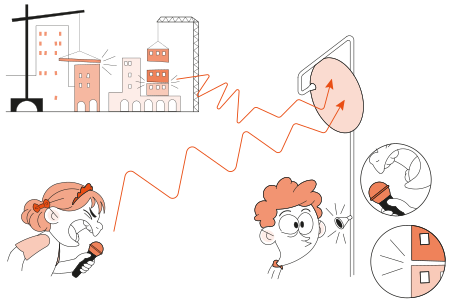
Sounds of the city
Put your ear to the funnel. You'll hear the sounds of the city. It's as if the street is at arm's length! All thanks to the parabolic antenna.

Guess the melody
Spread the big disks and you'll see animation! The pictures seem to come to life. This principle of changing frames is the basis of all movies and cartoons.
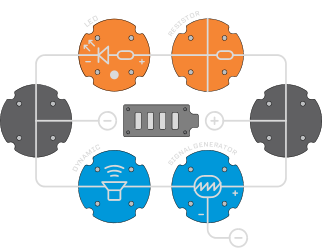
Assemble the electrical circuit
Do an experiment with current! Turn the knob to charge the battery. Assemble an electrical circuit by turning the wires, speaker, resistor, signal generator and LED.
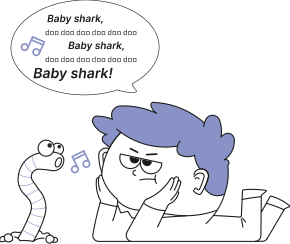
Put a melody together
Turn the knob to play the music. Can you mentally divide this melody into parts of different instruments? Let's give it a try! Move the tokens to the left (off) and right (on).
mail@leber.groupReference information
Privacy Policy
©2026, All rights reserved