How the movie was made
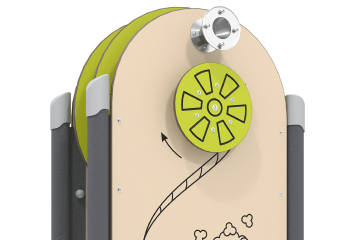
Spread the big disks and you'll see animation! The pictures seem to come to life. This principle of changing frames is the basis of all movies and cartoons.
Article by N+1
3 min to read · May 24 2023

present…
Instruction
Spin the large disks, gradually accelerate. Look through the peephole. The image will start to change, giving you the illusion of movement. The horse will gallop! This principle of changing frames is the basis of all movies and cartoons.
How it works
The invention of the gun, the discoveries of the Lumière brothers, technical progress and experiments are very interesting to learn. But none of this would be possible without visual perception features.
You have probably heard the expression "Frames Per Second" or FPS. It is a unit of measurement of frame rate. It shows how many images change each other on the screen in one second. After all, both movies and cartoons consist of many pictures. But for some reason we perceive them as a single whole. How is that possible?
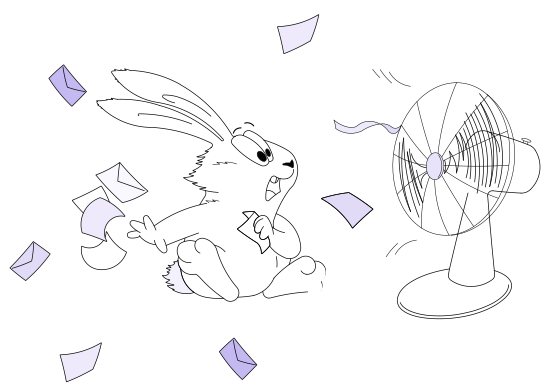
This ability is called visual inertia. For example, when a fan is running at high speed, you will see a blurred circle rather than individual parts.
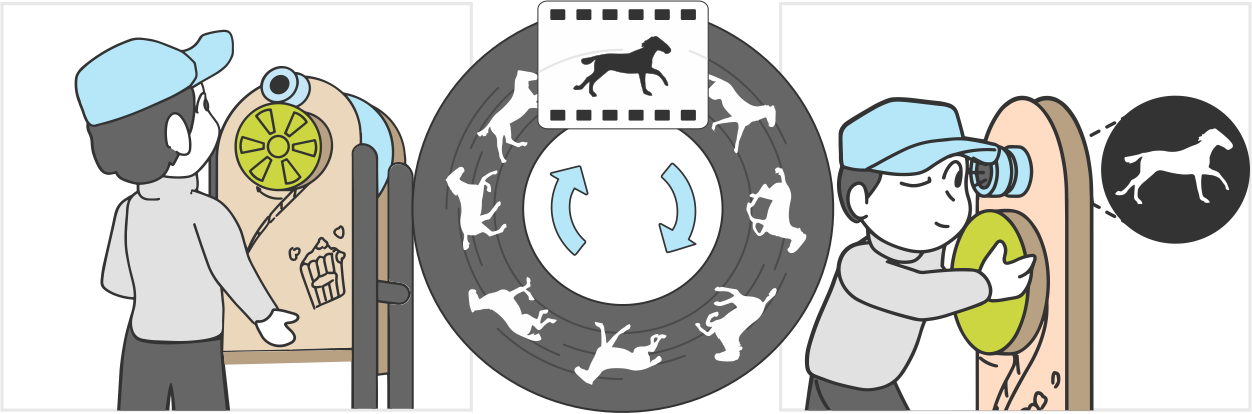
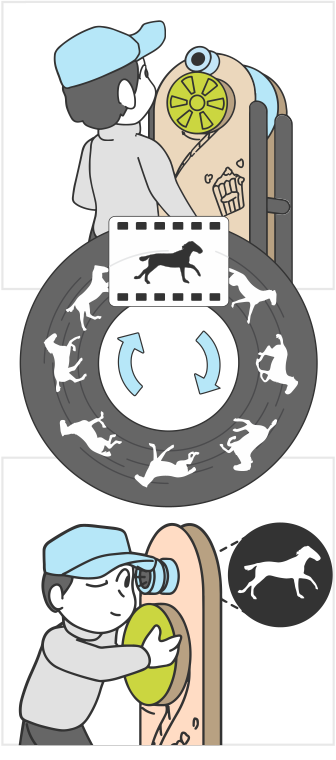
In cinematography, 24 frames per second is considered as a standard.
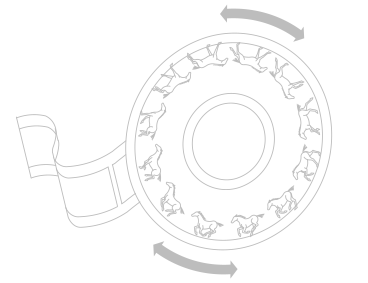
But that wasn't always the case. In the days of silent movies, the frame rate per second was chosen by a film mechanic. He was oriented to the mood of the audience and independently chose the pace of rotation of the film reel in the projector. For some viewers he showed the picture at a speed of 18 to 24 frames per second, for others he accelerated to 20-30 frames per second. Thus, the projectionist also acted as a director in his own way. You too can spin the disk at different speeds, thus changing the frame rate!
The horse movie has its own story. It was made by the photographer Edward Muybridge. He studied movement, and in his work he used several cameras simultaneously. This method led him to many important discoveries. And here's one of them.
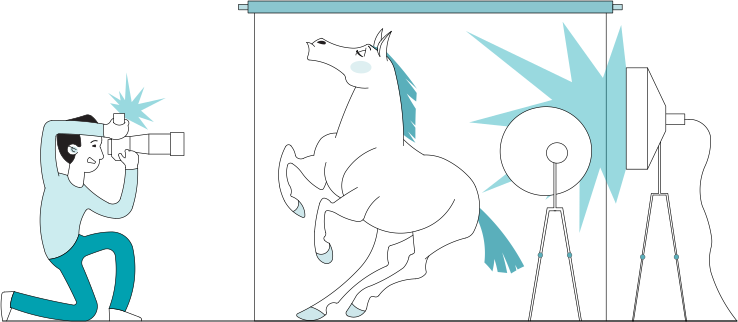
Maybridge once used photography to settle a dispute between governor Leland Stanford and two of his opponents. The governor argued that a horse running at a gallop pulls all of its hooves off the ground. The opposing view was that at least one hoof of a horse does not open from the ground when running. Maybridge then conducted an experiment.
The movement of the horse was recorded by 24 cameras, each capturing a different phase of the animal's movement. This experience allowed Muybridge to create his invention, the zupraxiscope, a device for "reproducing moving pictures". Inside it was a glass coil. On it were wound pictures of different phases of movement of people or animals. When the coil was spun, it created the sensation that the object was moving.
So how did the story end with the horse argument?

Click 'Find out' to find out
This article is about our product:
More articles by N+1
Electric Quest
Imagine you are an explorer. Every element here can be explored. Go through games for logic and dexterity, explore all possible moves and measure the strength of the wind.
Shadow play
Create your very own shadow theater! Choose the animals and other silhouettes you want to show and adjust their size with your hands.
Sounds of the city
Put your ear to the funnel. You'll hear the sounds of the city. It's as if the street is at arm's length! All thanks to the parabolic antenna.
Guess the melody
Spread the big disks and you'll see animation! The pictures seem to come to life. This principle of changing frames is the basis of all movies and cartoons.
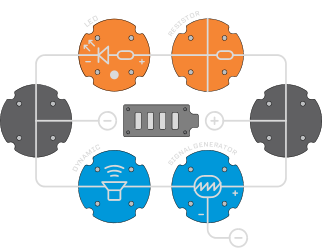
Assemble the electrical circuit
Do an experiment with current! Turn the knob to charge the battery. Assemble an electrical circuit by turning the wires, speaker, resistor, signal generator and LED.
Put a melody together
Turn the knob to play the music. Can you mentally divide this melody into parts of different instruments? Let's give it a try! Move the tokens to the left (off) and right (on).